Chemical Properties and Scientific Overview of Kratom
(Mitragyna speciosa)
Kratom (Mitragyna speciosa) is a tropical tree native to Southeast Asia, particularly Thailand, Malaysia, Indonesia, and Papua New Guinea. A member of the Rubiaceae family, it shares taxonomic similarities with coffee. The leaves of kratom are rich in bioactive alkaloids, primarily mitragynine and 7-hydroxymitragynine, which interact with the human opioid receptor system and contribute to its pharmacological effects.
Major Alkaloid Constituents
1. Mitragynine
o Represents up to 60% of total alkaloid content.
o A partial agonist at the μ-opioid receptor.
o Exhibits analgesic, anxiolytic, and mood-enhancing properties.
o Classified as an indole-based alkaloid with a complex polycyclic structure.
2. 7-Hydroxymitragynine
o Present at concentrations below 2%, yet exhibits significantly higher potency than morphine (~13
times) at μ-opioid receptors.
o Considered a major contributor to kratom’s analgesic efficacy.
o Demonstrates strong central nervous system activity.
Mechanism of Action
– Both mitragynine and 7-hydroxymitragynine bind to μ-, δ-, and κ-opioid receptors, with the μ-receptor
being most dominant.
– These interactions modulate central nervous system responses, leading to effects such as pain relief, mild
euphoria, and relaxation.
– Unlike classical opioids, kratom alkaloids generally present a lower risk of respiratory depression, though
potential for dependency remains.
Extraction Technologies for Alkaloids
To obtain standardized kratom extracts, various advanced extraction techniques are employed:
1. Supercritical CO₂ Extraction
o Principle: Uses supercritical carbon dioxide as a non-toxic, selective solvent.
o Advantages:
– Solvent-free, high-purity extracts
– Environmentally sustainable
o Limitations:
– Requires high-cost equipment and precise parameter control
2. Ultrasonic-Assisted Extraction (UAE)
o Principle: High-frequency sound waves create cavitation, improving solvent penetration and yield.
o Advantages:
– High efficiency and short processing time
– Cost-effective for commercial applications
o Limitations:
– Requires optimization of sonication parameters
3. Solvent Extraction (Ethanol/Methanol)
o Principle: Organic solvents dissolve the alkaloids from dried plant material.
o Advantages:
– Scalable for large-batch production
– Simple setup
o Limitations:
– Potential solvent residues must be addressed
4. Steam Distillation
o Principle: Utilizes steam to isolate volatile components.
o Advantages:
– Non-toxic and natural
o Limitations:
– Inefficient for non-volatile alkaloids like mitragynine
Analytical Tools for Alkaloid Quantification
1. High-Performance Liquid Chromatography (HPLC)
o Usage: Gold standard for determining mitragynine and 7-hydroxymitragynine levels.
o Advantages:
– High precision and sensitivity
– Multi-compound detection
o Limitations:
– Requires skilled operation and instrument calibration
2. Gas Chromatography-Mass Spectrometry (GC-MS)
o Usage: Ideal for profiling alkaloids in volatile extracts.
o Advantages:
– High sensitivity
– Structural elucidation capability
o Limitations:
– Requires derivatization and sample prep
3. UV-Visible Spectrophotometry
o Usage: Quick screening method for total alkaloid content.
o Advantages:
– Inexpensive and rapid
o Limitations:
– Less accurate compared to chromatographic techniques
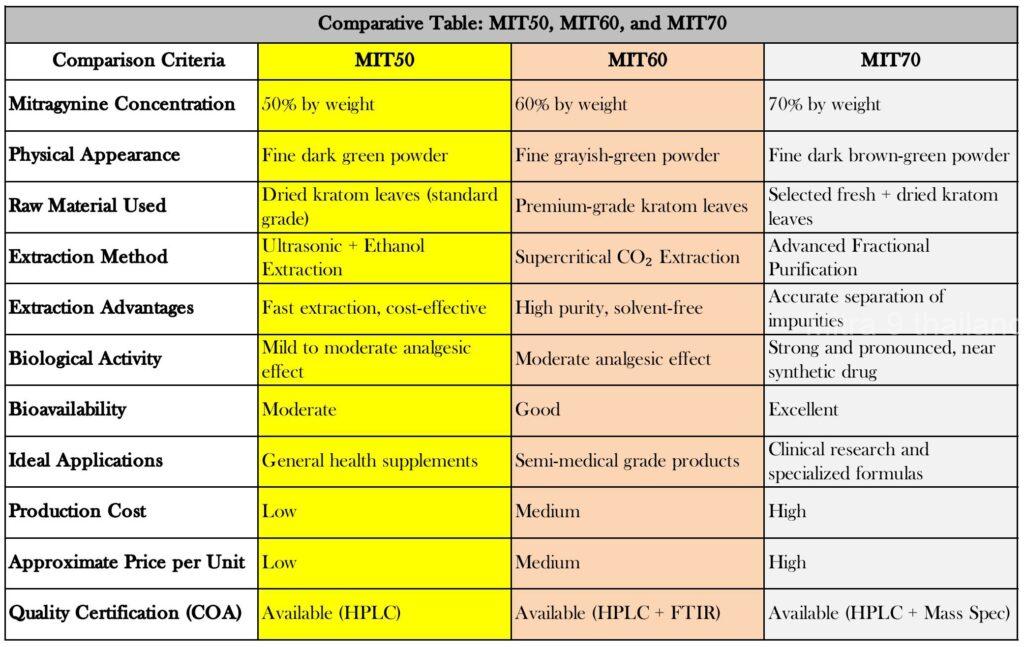
Comparative Analysis: Mitragynine Extract Grades
Concentration Purity Level Application Scope
MIT 50% Moderate Nutraceuticals, pilot studies
MIT 60% High Biomedical testing, functional products
MIT 70% Premium Pharmaceutical research and drug discovery
Advanced Product Specifications
– MIT 50%: Suitable for dietary pharmacological investigations.
– MIT 60%: Higher potency and bioavailability. Preferred for therapeutic prototypes and clinical formulation.
– MIT 70%: Pharmaceutical-grade extract. Ideal for precision medicine, receptor-binding studies, and novel drug development.
Scientific Significance of 7-Hydroxymitragynine
Despite its low natural abundance, 7-hydroxymitragynine is a key focus in opioid research. Its high efficacy at opioid
receptors suggests potential use in palliative care and chronic pain management with reduced adverse effects compared to traditional opioids.
Mitragynine vs. Morphine
Mitragynine displays partial opioid receptor agonism with significantly reduced respiratory depression and addiction potential compared to morphine. Its pharmacological profile allows for conscious-state analgesia, making it a safer
alternative for long-term treatment.
Industry Relevance and Future Development
Standardized mitragynine extracts (MIT50, MIT60, MIT70) are essential for:
– Nutraceutical and pharmaceutical formulation
– Cosmetic bioactives
– Research into semi-synthetic derivatives
They serve as a foundation for consistent, scalable, and regulatory-compliant production pipelines.
Public Communication and Education
Scientific outreach should emphasize:
– The natural origin and safety profile of kratom alkaloids
– The importance of standardized extraction and COA-based verification
– Potential therapeutic applications beyond traditional opioids
Clear and responsible communication will ensure informed public discourse and support future clinical adoption.